
- Published
Plug-in solar panels will be hitting the shelves of DIY shops and High Street retailers after the government changed the rules to allow them to be legally sold in the UK.
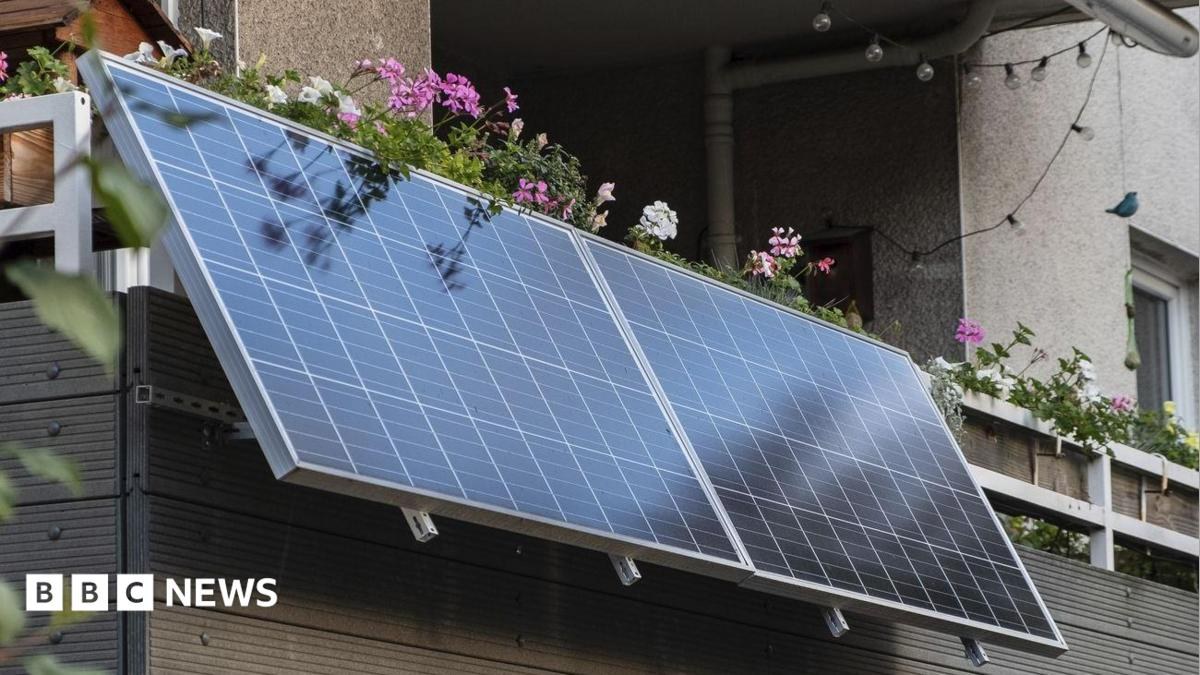
They are significantly cheaper than roof panels, can be installed without an electrician and are suitable for properties with outdoor space, including some balconies.
Retailers including Argos will be stocking products from Thursday, and the government expects other shops to follow suit.
It hopes plug-in solar panels will help households save money and reduce reliance on overseas fuel sources, the price of which has fluctuated in recent months due to the Middle East conflict.
Customers should get their wiring checked by a professional to ensure it is safe before parting with cash, experts say.
Will plug-in solar panels save me money?
The government hopes the plug-in panels will offer people a more affordable way into solar energy compared to roof installation, although savings will be lower because they generate less power.
A one-panel kit will cost £699 while two-panels will be £1,089, according to UK solar company UKSOL.
The government expects prices to settle at £400-£600 as competition increases and more products are developed.
Its research shows a household could save between £70 and £110 a year on their energy bills.
The precise amount will depend on how the panels are orientated and how long they run. An unshaded south-facing spot is best.
Households which use energy during daylight hours will benefit most as the electricity must be used as it is generated.
Any power not consumed will flow back to the grid, but it's unlikely homes will get any cash for this.
Unlike rooftop solar panels, these systems do not need to be certified under the official Microgeneration Certification Scheme (MCS), which is the UK's official quality mark for small-scale renewable energy systems.
But it also means they will not normally qualify for the Smart Export Guarantee that pays people for excess solar power.
How much energy can they generate?
The panels will make a difference to a household's power consumption but it is deliberately modest for safety reasons.
While kits may come with panels that are capable of generating more power, the microinverter - which turns the current from the panel into electricity homes can use - will limit output to the home to 800 watts.
That's enough to cover "always-on" electrical appliances such as fridges and devices left on standby. The government says it should power about a fifth of the average household's electricity use while the sun is shining.
Other essentials, such as the kettle which needs 3 kilowatts of electricity, will be powered through a mix of the 800 watts flowing from the panel with the rest coming from the national grid.
British Gas said plug-in panels won't solely power a home but can "meaningfully reduce how much electricity you need to buy during the daytime".
How safe are plug-in panels?
Government tests found sample systems could operate with no unacceptable heating or unsafe energy flows.
Each device comes with a microinverter which constantly monitors the connection to the grid.
If the electricity cuts out, from a power cut for example, or if the panel is simply unplugged, the microinverter senses that and shuts down in milliseconds so it can never push live electricity into dead wiring.
To be legally sold in Great Britain, new panels must be tested against the industry's G98 standard and the government's product specification.
If a panel meets these requirements, it will appear as compliant on the Energy Networks Association's public register, external, so it is definitely worth checking before buying.
Where will they be sold?
Consumer safety charity Electrical Safety First said buyers should stick to established retailers and their own websites rather than third-party sellers on online marketplaces.
It warned that some platforms are not currently legally responsible for the safety of goods sold through them.
Are these devices suitable for every home?
Not necessarily, according to Electrical Safety First, which has published a list of steps, external to help households reduce any risks before buying.
The charity's main worry is that plug-in solar can interact with older safety devices in some home electrical systems.
It recommends having electrics checked by a registered electrician before buying panels, particularly in older properties or where the age and condition of the wiring is unknown.
It also said households should never connect one through an extension lead, cable reel or plug-in adaptor, as these can overheat.
And for now, it advises sticking to a single plug-in device per household.
How do I install one?
The panels will come with a mounting kit and instructions. Tools may be needed but professional installation isn't required.
Once mounted, connect the microinverter and plug into a mains socket - ideally a external socket that is weatherproof.
They aren't permanently attached so they can be moved to a different property.
People may need permission from their landlord, freeholder or building owner.
Households will need to let the electricity Distribution Network Operator (DNO) know within 28 days of plugging the panel in. This is the company that owns the cables in the area, not your energy provider.
Find them by using National Grid's postcode tool., external
Related topics
-
- Published15 June
-
- Published24 March