
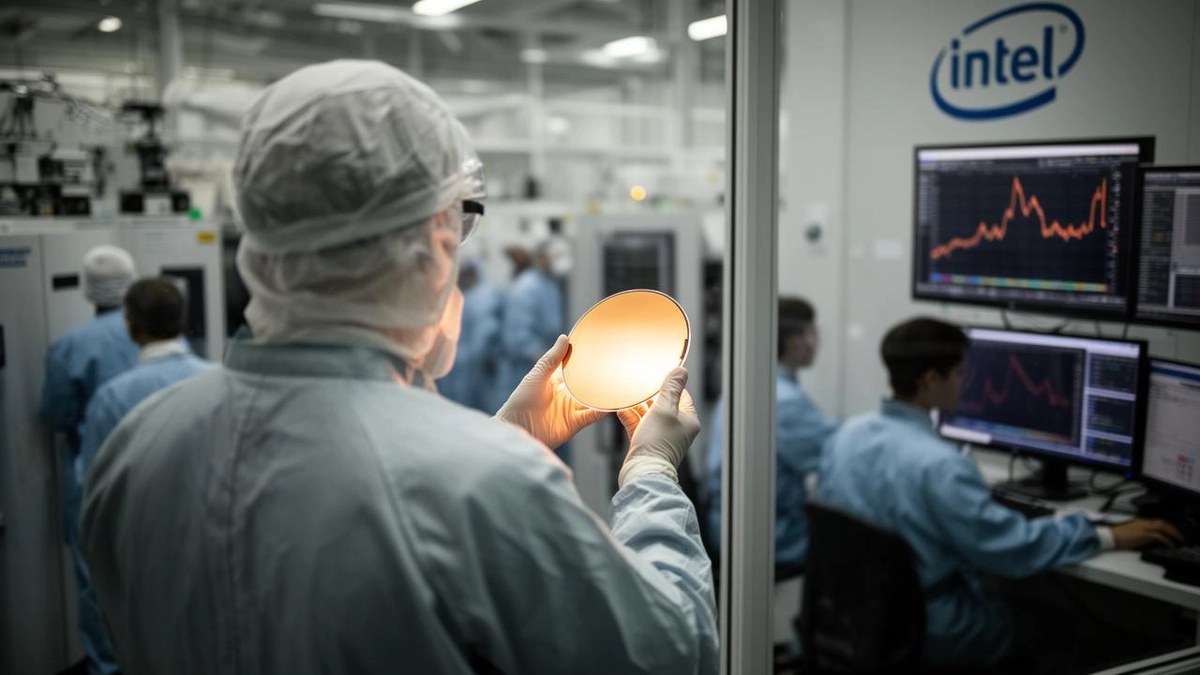
Intel Corp. (INTC) just pulled off one of the largest equity raises in semiconductor history -- and Wall Street is debating whether the $20 billion deal is a sign of strength or a red flag. The chipmaker priced 210.5 million shares at $95 apiece on Monday, then upsized the offering from its original $15 billion target after demand came in hot. CEO Lip-Bu Tan said on X that the deal was oversubscribed by more than five times.
The market's initial reaction was to sell the news. Intel shares fell Tuesday as investors digested the dilution, but the stock rebounded nearly 2% in Wednesday's pre-market trading. Bank of America analyst Vivek Arya reiterated a Buy rating while trimming his price target to $145 from $160, arguing the capital raise is a bullish tell for Intel's foundry ambitions rather than a defensive balance-sheet move.
The offering is expected to close Wednesday, with net proceeds of roughly $19.7 billion if underwriters don't exercise their 30-day option to buy up to 31.58 million additional shares. Intel said the funds will go toward general corporate purposes, including working capital and capital expenditures, with 2026 capex expected to exceed $20 billion.
Foundry Confidence or Earnings Headwind?
Arya's math is straightforward: the higher share count will dilute earnings per share by about 4% to 5%. That's the near-term cost. The long-term payoff, in his view, is a foundry business that could scale into a meaningful chunk of a roughly $380 billion wafer foundry market by 2030.
Bank of America's model projects Intel Foundry revenue climbing from about $1.1 billion in 2026 to nearly $40 billion in 2030. The firm sees Intel capturing 8% to 10% of the wafer foundry market and 25% to 30% of an estimated $20 billion market for advanced 2.5D and 3D packaging. Potential customers could include Apple for silicon wafers, MediaTek for packaging, and Terafab for ARM-based server processors -- though none of those specific deals are baked into BofA's base case.
The analyst also flagged Intel's progress on its 14A manufacturing process and the possibility of additional external customer wins involving 18A-P, 14A, and advanced packaging as catalysts for further spending. "The deal signals increasing management confidence in both internal data center demand and external foundry customer engagement," Arya wrote.
Intel's server processor unit is another pillar of the bull case. According to Mercury data cited by Bank of America, Intel's server average selling prices jumped 43% year over year to a record of roughly $1,200 in the second quarter. The firm projects server CPU sales could reach about $45 billion by 2030, representing roughly 20% of an estimated $220 billion addressable market.
BofA trimmed its 2026, 2027, and 2028 earnings estimates by 2%, 4%, and 3%, respectively, to account for the expanded share count. The firm now expects adjusted EPS of $1.47 in 2026, $2.01 in 2027, and $2.92 in 2028. By 2030, BofA sees Intel generating earnings power of more than $6 per share.
Not everyone is convinced the market got it wrong. Jeff Kilburg, a tech investor who bought the post-offering dip, argued that Intel is raising capital to meet AI demand without straining its balance sheet or credit rating. He called the offering strategic because Intel is raising funds at a much higher share price than during previous capital raises -- the stock is up 165% year-to-date and 373% over the past 12 months.
Dan Niles, another tech investor, said the larger raise strengthens his view that Intel may be nearing major foundry customer deals that require additional capacity.
Retail sentiment on Stocktwits, however, trended bearish at the time of writing, suggesting the short-term dilution concerns are weighing on individual investors even as institutional analysts defend the move.
The U.S. government, which held a 9.9% stake in Intel prior to the raise, did not participate in the offering, according to reports. Commerce Secretary Howard Lutnick approved the stock offering plan after Intel's CEO reached out to him last week, underscoring the government's continued involvement in the chipmaker's strategic direction.
Intel's chart tells a story of a stock in a longer-term uptrend that has hit a rough patch. Shares remain 9.5% below their 50-day simple moving average of $109.84, while the 20-day average sits below the 50-day -- a sign of continued near-term pressure. The relative strength index stands at 46.48, indicating neutral momentum.
Key support sits at $89.50. A break below that level could accelerate downside pressure. On the upside, bulls will look for the stock to reclaim its 50-day moving average. The longer-term trend remains intact: Intel's 50-day SMA crossed above its 200-day average in August 2025, forming a golden cross.
Intel carries a Hold consensus rating with an average price target of $109.07, according to data compiled from 50 analysts. Recent actions show a wide range of views:
Note: Price targets reflect the most recent updates from each firm as reported in the source articles.
The capital raise is a high-stakes bet on Intel's transformation from a PC-centric chip designer to a full-fledged foundry player competing with TSMC and Samsung. The company has spent years and billions of dollars building out its manufacturing capabilities, including the 18A and 14A process nodes that are critical to its foundry ambitions.
If Arya's thesis plays out, the dilution from this offering will look like a rounding error by 2030. If execution slips -- whether on process yields, customer acquisition, or market share against CPU rivals -- the $20 billion raise could be remembered as the moment Intel doubled down on a losing hand.
For now, the market is giving Intel the benefit of the doubt. The stock's rebound in pre-market trading Wednesday suggests investors are willing to look past the near-term dilution and focus on the demand signal embedded in the oversubscribed offering.
Key risks, according to Bank of America, include execution and yields on Intel's 18A and 14A processes, the pace of securing major external foundry customers, and further market-share losses to CPU competitors.
Once added, BigGo Finance appears first in Google Search Top Stories, so you get the broadest, most up-to-the-minute, and most comprehensive global financial news first.