
Short-term fair value has slipped below 1.150 for the first time since late July, while the two-year SOFR ESTR spread has widened back toward 150bp, also around levels last seen in July. Interestingly, oil now carries only a small beta in the model. Equities and rate differentials are doing most of the work, which fits the price action almost perfectly.
Fed Hawks Keep Dollar Bid
The dollar had every excuse to soften. Oil was lower, equities were firmer, and the usual reflex would have been to bleed some inflation premium out of US front-end rates. Instead, the greenback started the week with a bid because the Fed refused to follow crude lower, and because the energy story itself is changing shape.
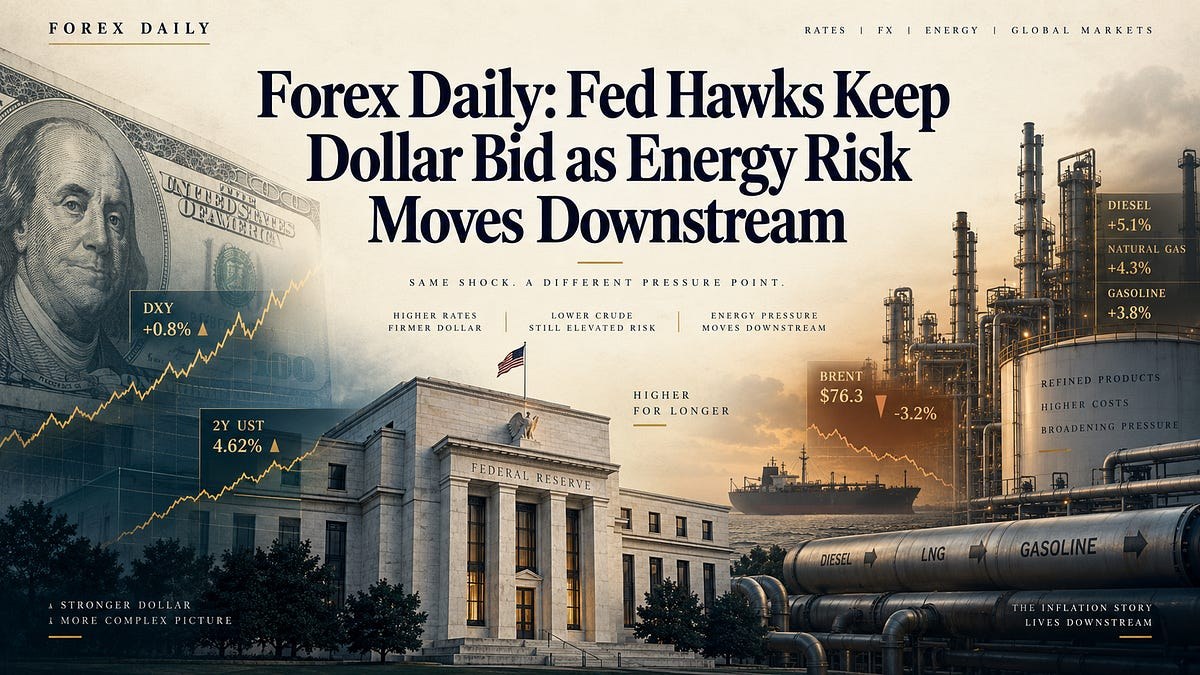
Brent slipping back below $100/bbl sounds comforting, but oil is still coming off an elevated starting point. More importantly, the inflation worry has moved downstream. For weeks the market stared at the Strait of Hormuz as if every inflation risk began and ended with ships getting through the channel. That was the first-order shock. The pressure is now showing up further along the chain in diesel and refined products, where energy costs move much closer to transportation, industry and the household wallet.
So a few dollars off Brent does not suddenly buy the Fed an inflation all-clear.
Against that backdrop, hawkish Fed commentary remained the clearest driver of the dollar.
Chicago Fed President Austan Goolsbee warned that supply shocks, combined with strong spending and AI-related investment, could keep inflation persistent, adding that the path back to 2% may not be painless. That was not just another hawk banging the table. Goolsbee is a non-voter in 2026, but he sits close enough to the centre of the FOMC spectrum to matter as a read on where the committee consensus may actually be drifting.
That made the message harder for the rates market to wave away. If a centrist Fed voice warns that supply shocks and AI investment could keep inflation sticky, then softer headline crude does not automatically translate into softer policy expectations, especially when pressure has migrated into products that hit the real economy more directly.
St. Louis Fed President Alberto Musalem then reinforced the same direction from the more hawkish side of the board, arguing that gradual tightening should be front-loaded and that policy remains accommodative. He may also sit among the officials who pencilled in two additional hikes this year. Again, Musalem does not vote in 2026, but put him beside Goolsbee and the message becomes difficult to miss: the Fed is not looking at lower Brent and seeing the problem disappear when we’re still trading near $100.
There was also some catch-up after Friday’s reported Bank of Japan rate check knocked USD momentum sideways, but Monday looked much more like the market resetting the furniture than changing the room. The broader dollar structure remains supported as long as US front-end rates keep refusing to join the global correction.
DXY at 101.0 before month-end therefore no longer looks like much of a stretch. The US data calendar is light, giving Fedspeak more room to set the marginal price, and today’s appearances from John Williams and Philip Jefferson could matter more than usual because they sit closer to the dovish side of the Fed spectrum. If those voices start leaning even slightly hawkish, the market may have to widen the path for additional tightening again. Tom Barkin, closer to neutral and also a non-voter, adds another voice to the mix.
The Fed does not need every official singing from the same hymn sheet. It just needs enough of the middle to stop the market from pricing an easy glide back toward lower rates.
EUR/USD is where that relative rate story shows up most cleanly. According to ING Analysts
The ECB is still talking tough, and October remains firmly on the table, but FX markets are increasingly willing to look through the rhetoric and trade the relative rates picture. That is usually where the euro gets into trouble. Central banks can both sound hawkish, but if one curve is moving more aggressively than the other, the currency market eventually follows the spread.
Right now, the dollar is still winning that argument.
The medium-term view is less one-sided. Hawkish expectations may ultimately prove too aggressive on both sides of the Atlantic, with one additional hike from both the Fed and ECB this year and no further tightening in 2027 still a reasonable baseline. That can support EUR/USD back toward 1.160 by year-end, especially if US data weakens.
If the Fed keeps the US front end pinned while Europe loses even a little of its hawkish premium, EUR/USD remains vulnerable to another test of the 1.1300. FX has a habit of walking through the nearest open door first, and right now that door still points lower.
Another wrinkle in Europe is worth keeping on the screen. The French 10-year spread over Bunds has reached 100bp. The euro has treated that widening with relative calm so far, but political and fiscal stress rarely stays politely locked inside the bond market forever. If that spread keeps moving while the US rate advantage remains intact, the euro picks up another piece of baggage at exactly the wrong time.
So the dollar story is cleaner than the move in crude would suggest. Oil is lower, but it is lower from a high level, while the real energy pressure has moved downstream into diesel, natural gas and refined products. At the same time, Goolsbee has given the hawkish message credibility from the centre of the Fed, Musalem has reinforced it from the harder edge, and the US front end is refusing to roll over with the rest of the G10 complex.
Hormuz may no longer be the only fire alarm in the building.