
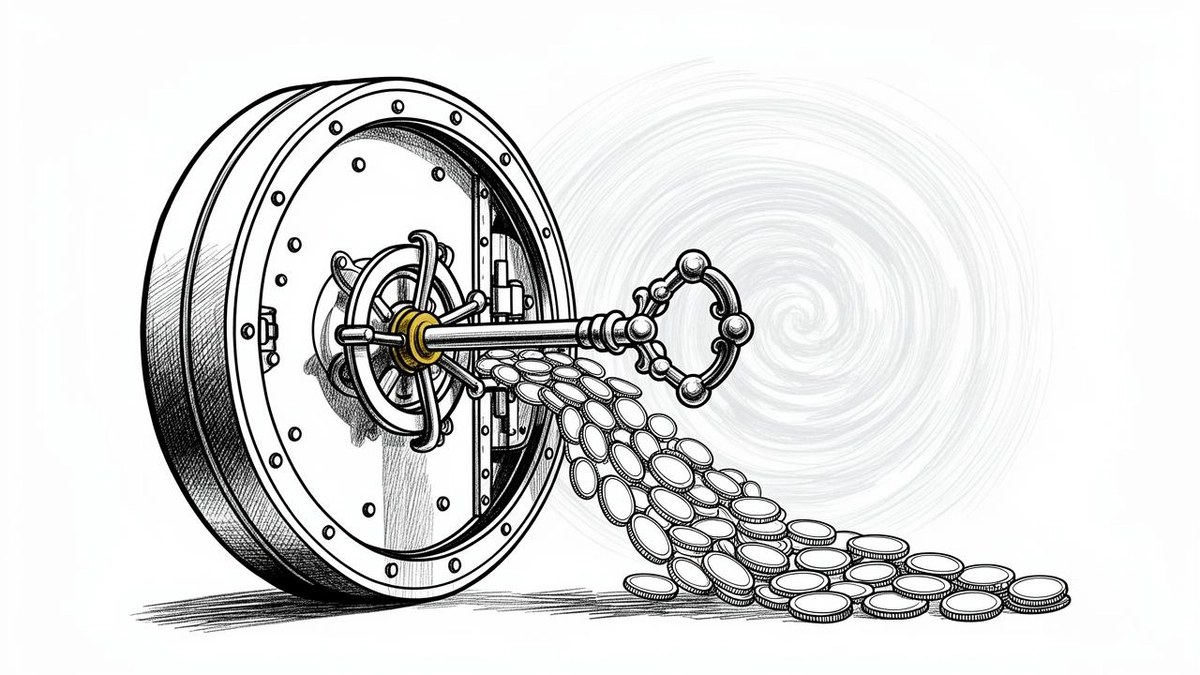
Chainflip, a cross-chain swap protocol, lost roughly $4.86 million in Ether and stablecoins from its Ethereum vault on Nov. 21 and immediately put the entire protocol into Full Safe Mode, halting swaps, deposits, withdrawals and price quotes while investigators examine whether the vault's cooperative signing key was compromised.
Blockchain trackers Onchain Lens and AMLBot flagged the outflow. A single transaction at 07:10:59 UTC carried 520.2 ETH, 3.25 million USDC and 758,000 USDT away from the vault to one destination address, according to the transaction record shared by Onchain Lens. At the dollar values shown in that record, the Ether portion accounted for about $850,000, the USDC for roughly $3.25 million and the USDT for about $757,000, putting the two stablecoins at about 82% of the total.
The detail that has drawn the most scrutiny is authorization. The transfer bore a valid signature from the vault's aggregate signing key, which under Chainflip's design is produced collectively by its validator set rather than by any single node. Onchain Lens pointed to that signature as evidence that the key itself may have been compromised. How the signature was obtained has not been established.
"We believe the laundering was scripted and automated end to end," AMLBot said in a follow-up post, adding that it was continuing to monitor the funds.
According to the analytics firm, both stablecoins were swapped into ETH on Uniswap within four minutes of the withdrawal, ahead of any action by their issuers, and nearly the entire balance was pushed into Tornado Cash within nine minutes. Onchain Lens tracked about 2,909 ETH, worth roughly $4.75 million at the time of its report, into transactions involving the mixer. That later figure overlaps with the original withdrawal because it includes proceeds from the stablecoin conversions.
Tornado Cash pools deposits so that inbound and outbound funds are difficult to link, and the mixer remains under U.S. Treasury sanctions. Routing the proceeds through it creates potential legal exposure for anyone ultimately identified with the transactions.
Chainflip's team confirmed the Full Safe Mode shutdown as a precaution, describing it as a circuit breaker meant to stop further unauthorized outflows while the scope of the incident is assessed. The protocol had not published a formal incident post on its blog as of the reporting, and updates were expected through its account on X.
FLIP Sinks as Exit Routes Close
The token bore the brunt of the reaction. FLIP fell 39.46% on the day to about $0.2887, cutting its market capitalization to roughly $24.85 million, according to CoinGecko data. The drop landed on top of a 32.96% decline over the preceding seven days, so the token was already weak before the exploit compounded sentiment.
The broader market offered no cushion. The Fear & Greed Index stood at 12 out of 100, deep in Extreme Fear territory. With the protocol shut and normal swap routes unavailable, holders had little choice but to sell into a thin bid.
Chainflip's buy-and-burn design adds a mechanical second channel of pressure. The mechanism relies on swap volume to retire tokens; with trading at a standstill, that deflationary support is paused precisely when it would otherwise absorb selling.
Note: Figures are as reported on Nov. 21, 2026, by Onchain Lens, AMLBot and CoinGecko.
A Second Loss in Under Three Months
The scale of the hit relative to the protocol's size is stark. Chainflip's total value locked stood at approximately $9.36 million at the time of the incident, according to CoinGecko protocol data, meaning the drain represents well over half of the assets the protocol was securing, before any question of user losses is considered.
It is also the second loss event of 2026. On Sept. 12, the protocol lost 736,442 USDT on TRON after a flaw in how its integration handled transaction memos caused six liquidity provider withdrawals to be paid twice, leaving that vault short. Chainflip covered the shortfall after validators approved a plan to return whatever TRON USDT could be recovered and credit affected providers with USDC one-for-one; the Sept. 18 accounting put the amount covered at $748,935.16. The same proposal showed the Ethereum vault holding just over $1.08 million in surplus USDC at the time, which the team attributed to sources including excess gas-fee accounting and deposits sent to expired channels or the wrong network.
The two incidents differ in kind. September's was a software-layer bug in one chain integration; November's appears to target the cryptographic infrastructure that underwrites every vault the protocol operates. Chainflip had also disclosed an attempted exploit in August involving cross-chain messages and refunds on Ethereum, pausing deposits and quotes on Ethereum, Arbitrum and TRON while it investigated, and said at the time that no user funds were lost and a network upgrade was ready about a day after the first report.
What Comes Next
Assets on Chainflip remain frozen. The available research does not establish the condition of user funds inside the protocol beyond the confirmed vault outflow, and the team has not disclosed a root cause.
Three questions will shape the outcome. The first is whether additional unauthorized transactions exist beyond the single transfer identified. The second is how the aggregate signing key was obtained and whether that path has been closed, a question that goes to the core of the threshold signature scheme on which every vault depends. The third is the timeline for restoring functionality.
For the market, the immediate read is that cross-chain infrastructure remains the softest target in decentralized finance, and that a valid signature is no longer proof of legitimate authorization. For FLIP holders, the token's near-term direction is tied less to the technical fix than to how candid the team is during the investigation window, since trust, once spent, is the hardest balance sheet item to rebuild.
Once added, BigGo Finance appears first in Google Search Top Stories, so you get the broadest, most up-to-the-minute, and most comprehensive global financial news first.
Add preferred source