
- Published
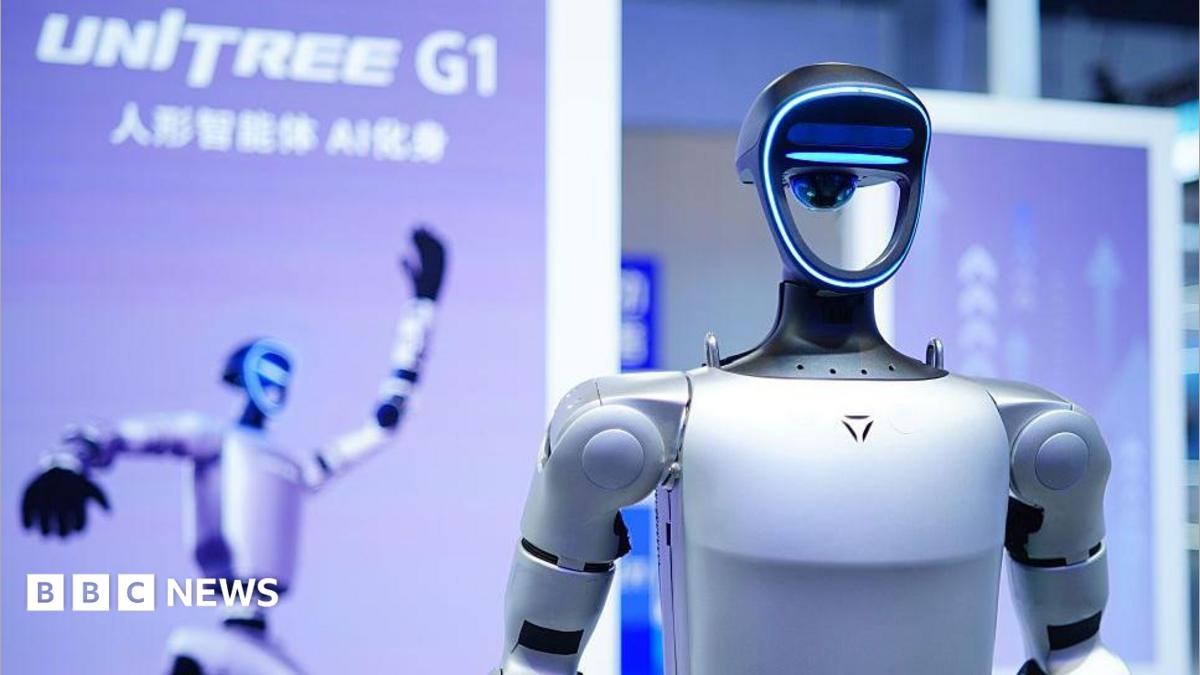
The world's biggest humanoid robot maker Unitree Robotics made its stock market debut in Shanghai on Wednesday, with its shares soaring by more than 600% in early trading.
In the highly anticipated initial public offering (IPO), the Chinese firm's shares opened at 1,100 yuan (£120.60; $163.12), before giving up some of the gains to trade at around 900 yuan.
The listing on the technology-focused Star Market - which is widely known as China's Nasdaq - marks a milestone for Beijing's ambitious plans for the country's robotics industry.
It comes as the US and China are battling to dominate the global market for robots and artificial intelligence (AI) models that power them.
While Unitree is not the first Chinese humanoid robot maker to list on the stock market, its debut marks the first in mainland China.
Robots like automated industrial equipment and smart vacuum cleaners are already widely used in factories, warehouses and homes.
Now, the humanoid robotics industry is attracting huge amounts of investment as major companies - including Tesla, BYD and Amazon - are developing two-legged machines capable of performing tasks usually carried out by people.
What is Unitree?
Unitree, officially known as Yushu Technology Co Ltd, was founded in 2016 and now plays a key role in Beijing's ambitions to develop advanced technology.
It has become a robotics industry leader, selling devices from sensors and automated arms to four-legged and human-like machines.
The firm shipped more than 5,500 humanoid robots last year as demand for the technology grows.
Unitree is one of the few companies in the sector to make money, delivering a net profit of 278 million yuan in 2025.
It is a fierce rival to developers in the US as it produces robots with similar features but at lower prices.
The company is based in Hangzhou, in eastern China. The region is home to a so-called golden cluster zone of robotics firms, which have benefited from huge government investments.
That support helped drive a more than threefold increase in the number of Chinese robotics firms between 2020 and 2024, according to state-run China Daily.
Robots are also seen as a potential solution to issues posed by China's ageing population, which is expected to lead to a shortage of workers in the country, according to Fei Qin, an associate professor at the University of Bath.
Beijing considers the robotics sector a "strategic priority" in its pursuit of leadership in advanced technology, she said.
"Robots are where AI leaves the screen and enters the economy" in factories, hospitals and, potentially, the home, Qin added.
US robots tend to have more user-friendly software but it is difficult to ignore the lower prices offered by Chinese manufacturers, said Harold Soh, a researcher from the National University of Singapore.
Unitree's robot dogs start at $2,700, a fraction of the roughly $70,000 price tag for Boston Dynamics' four-legged device, Spot.
"They're not exactly comparable because some of Unitree's dogs are much smaller," Soh said. "But the price is a big difference."
Unitree has been selling humanoid robots since 2023, with its $13,500 child-sized G1 model hitting the market the following year.
Meanwhile, major US rivals - including Elon Musk's Tesla - have yet to start delivering rival products.
Unitree robots have been at the centre of a huge marketing push ahead of the firm's IPO.
This week, its machines are competing in the 2026 World Humanoid Robot Games in Beijing. The event features hundreds of teams competing in events such as running and football as well as less sporty challenges like box opening and sorting library books.
In February, Unitree's robots caught the eye of the public and researchers when its G1 robots put on a display of martial arts moves during China's Spring Festival Gala.
The live broadcast showed the robots performing a range of moves "in a way we'd never seen before," said robotics researcher David Hsu.
"It was an indication of a rise of an industry," Hsu added.
A bellwether for robotics firms?
Some experts expect Unitree's market debut to be a gauge of investor appetite for the fast-growing humanoid robotics sector.
The listing has given the public a rare chance to invest in a humanoid robotics company and could set a benchmark for other manufacturers, said Jack Pearson from investment firm RoboStrategy.
The listing also marks a "turning point" for China's robotics industry, as Unitree's success comes even as the US is curbing imports of foreign-made robots, Pearson said.
Unitree's IPO comes almost three years after smaller Chinese rival UBTech Robotics listed on the Hong Kong stock market.
In July this year, UBTech drew global attention when it unveiled what Chinese state media described as a "hyper-realistic" robots designed to offer "emotional support and everyday interaction."
More robot makers, including Leju Robotics and AgiBot, are expected to follow UBTech and Unitree with stock market listings in the coming months.
But the optimism around the industry comes as some experts have voiced doubts over demand for robots for uses outside industrial and commercial settings.
Robots are still years away from working effectively in homes, Soh said.
Developers need to address issues like longer battery life, privacy safeguards and reliability, he said.
Initially, the market will be for robots being used in places like factories and hospitals, he added.
China-US tech rivalry
Robots and AI have become the latest flashpoint in the rivalry between the US and China, as both nations view them as strategically important industries.
US President Donald Trump's administration said in July that it would ban new Chinese-made humanoid and quadruped robots over national security concerns and protecting US manufacturing.
Beijing rejected the claim, accusing Washington of "politicising" trade issues.
The US has also set tough restrictions on other Chinese technology - including AI models and electric cars.
China's dominance of the robotics industry highlights a broader issue faced by Washington as Chinese firms become more "deeply embedded" in global manufacturing, said Christine Wan from the Peterson Institute for International Economics.
Other countries may be reluctant to reduce their reliance on Chinese suppliers at the risk of disrupting domestic manufacturing, Wan said.
-
Why human-shaped robots loom large in Musk's Tesla plans
- Published7 November 2025
-
Who will win the race to develop a humanoid robot?
- Published25 April 2025
-
The Chinese robot army transforming the UK's retail industry
- Published29 July
So far, Western robots have not made the same impact on factory floors or in the consumer market.
Boston Dynamics, a major US robotics developer, has said it will roll out human-like machines in car maker Hyundai's factories in two years' time. The South Korean firm has a majority stake in Boston Dynamics.
Other US firms, like Amazon and Tesla, have also announced plans to use humanoid robots in their operations.
Earlier this year, Musk's firm announced that it would use its manufacturing plant in California that made Model S and X cars to produce its line of Optimus humanoid robots.
Amazon, which tested the use of humanoid robots in its warehouses in 2023, told the BBC it is continuing its research into next-generation robotics.
The BBC has also contacted Tesla and Boston Dynamics for comment on their humanoid robot plans.
One thing is clear, said Hsu, the US has lost its lead in robotics.
"We no longer hear about American robotics companies in the news. It's the Chinese robot companies that are making news today," he added.
"They have replaced America as the cool kids on the block."
Listen to the BBC News World Service Asia Specific podcast: