
- Published
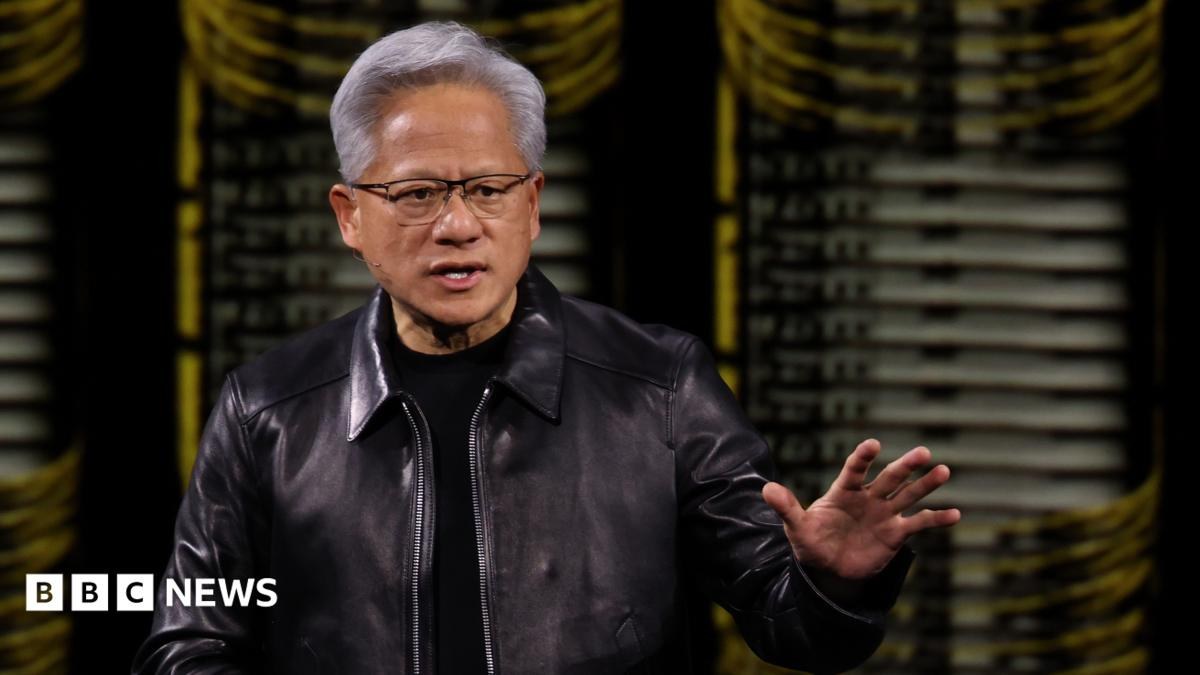
Jensen Huang is out but his shadow looms over the upcoming meeting between US President Donald Trump and his Chinese counterpart Xi Jinping this week.
For Beijing, the former Nvidia CEO's dramatic fall is a major challenge - and not just because of claims that a Chinese spy may have honey-trapped Huang, one of the artificial intelligence industry's most influential figures.
Rather, the allegations surrounding Huang and his affair with Chinese businesswoman Alice Huang are turning into a new flashpoint in an already fragile US-China relationship.
US intelligence reports claim she had ties to Beijing's intelligence apparatus - in particular the Ministry of State Security, China's main civilian spy agency.
The claim remains unproven, but it has already reignited debate in Washington over exports of advanced chips to China and whether the Trump administration has been too willing to ease restrictions.
For years now, advanced computer chips have been a key battleground in the US-China rivalry because they are essential for AI, supercomputing and military technology.
Chinese officials are worried this scandal could strengthen voices in Washington who argue in favour of further limiting Chinese access to cutting-edge American tech.
Just this week, the Trump administration introduced new export restrictions on Chinese firms that access advanced US chips in third countries such as Malaysia, Thailand or Brazil. They typically do this by renting computing power in data centres abroad to train their AI models. But some of the firms, like the one Alice Huang worked for, are also accused of smuggling chips to China, although they have denied this.
Until now, this controversy appeared to be a sideshow in US-China relations. But with Beijing calling the new rules "economic coercion" on the eve of Trump arriving in Shenzhen, there is a growing risk it could become something much bigger.
Democrats, who will control Congress come January, have made their position clear. Last Wednesday top Democrat Ted Lieu told Politico the Trump administration had been "1,000%" too deferential to Nvidia, putting national security at risk, while fellow Democrat Zoe Lofgren suggested Congress would now be more likely to restrict sales of AI chips to China.
The BBC has approached the White House for comment.
Beijing's foreign ministry had described the spy claims as a "smear against China".
"The US should stop fabricating so-called espionage narratives to find pretexts for imposing technological blockades," spokesperson Mao Ning said last week.
The ministry also seemed keen to keep the meeting on track, saying the two countries had kept "close communication regarding interactions between the two heads of state".
Another 'spy balloon' incident?
For the last year, Trump and Xi have been seeking to stabilise relations after a damaging tariff war that almost brought trade between the two countries to a standstill.
The Trump administration's decision to permit sales of advanced Nvidia H200 chips to China in late 2025 was seen as evidence that both sides were searching for areas of co-operation, even while competition intensified.
It was a rare move given Washington had spent years trying to limit China's access to the most advanced chips.
Many in the US have long viewed these chips as a national security issue, arguing they could strengthen China's military and surveillance capabilities. Jensen Huang, who rejects that claim, advocated lifting bans on the export of high-performing chips to China. Beijing argues the restrictions are an attempt to contain its rise.
History has taught Beijing and Washington that spy scandals rarely remain confined to the intelligence world.
Analysts in China already see echoes of an incident in 2023 when a suspected surveillance balloon drifted through the skies over the US before an American fighter jet shot it down. Beijing insisted it was a civilian meteorological airship that had strayed off course.
But a planned trip by then US Secretary of State Antony Blinken was cancelled and communication between the two governments deteriorated sharply.
The incident showed how quickly a security dispute could overwhelm diplomatic efforts and push relations into a deep freeze.
"The mere passage of a balloon sent American public opinion and politicians into a state of high alert, as if a "Chinese threat" were looming directly overhead," said the state media outlet, the Global Times this week as it made a direct comparison with the Nvidia scandal.
"No-one on the US side has ever apologised or taken responsibility for the genuine damage this caused to US-China relations," it added.
The state-run outlet also questioned why the Nvidia story had emerged so soon after "the hard-won detente" between Beijing and Washington, following a meeting between the two countries' leaders in September.
"Is someone behind the scenes pushing an agenda and stirring up confrontation?" it asked.
Trump-Xi summit unlikely to collapse
Both Trump and Xi have significant incentives to keep talking.
China's economy remains under pressure and is increasingly reliant on exports. Xi needs trade to keep flowing and this meeting is a key stepping stone to replacing the current trade truce that is due to expire in January.
Meanwhile Trump has repeatedly touted his close relationship with Xi and argued that maintaining dialogue is essential to managing competition between the two powers.
The US president is in his last two years and faces an uphill struggle to pass domestic legislation after the midterms. To counter this, he could be looking for some foreign policy wins.
He may also hope for Xi's help to end the war in the Middle East.
Neither side will want to be discussing intelligence concerns and technology controls instead of trade, investment and economic co-operation.
The summit is also being carefully choreographed by Beijing to show off its technological prowess in Shenzhen - a deeply symbolic choice of city.
It's home to some of the country's biggest tech companies and has become a showcase for Beijing's ambitions in AI and advanced manufacturing.
Also, given Washington's tighter restrictions on advanced chips, Beijing has options for retaliation.
One of its most powerful tools is its dominance of key rare earth minerals. China processes much of the world's supply for materials that are used in everything from electric vehicles and smartphones to military equipment.
Analysts have long warned that technological restrictions can trigger a cycle of retaliation in which each side reaches for its strongest economic leverage.
That would shift the current trend of US-China relations from engagement back towards mutual suspicion.
-
- Published14 hours ago
-
- Published5 days ago